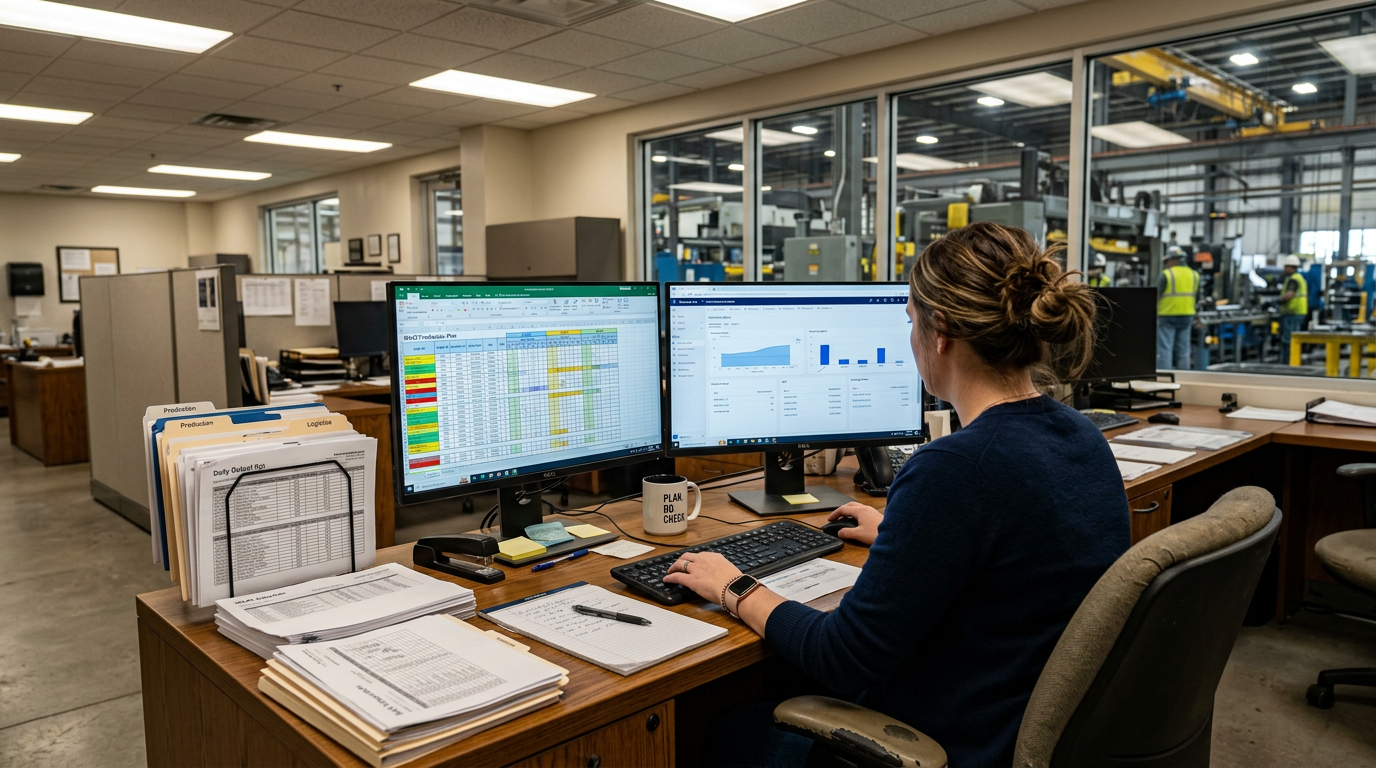
The ERP went live years ago. It handles orders and invoices. But scheduling happens on a whiteboard, inventory is tracked in a spreadsheet the planner trusts more than the system, and quality records live somewhere else entirely. You are paying for the whole system and using perhaps half of it.
The frustrating part is that nobody decided this. It just drifted there.
The ERP is the official system of record, but not the real one. People enter what they must and manage the rest elsewhere. Modules that were purchased are unused or only partly configured. New employees are taught the workarounds alongside the system. And when leadership asks a question that spans departments, answering it means pulling exports from the ERP and reconciling them against three spreadsheets.
Go-live was treated as the finish line. Implementations often focus on getting the core running. Everything else was deferred to a "phase two" that never came.
The system did not match the process — so people kept the old one. When the ERP does not fit how work actually flows, people route around it. Over time, the workaround becomes the process.
Key knowledge left. The people who understood the configuration moved on. Nobody now knows why things were set up the way they were, so nobody dares change them.
Nobody owns the system as a business tool. IT keeps it running. But nobody is accountable for how well the business actually uses it.
Data trust eroded. Once inventory or scheduling data in the ERP proves unreliable, people stop relying on it, which makes it less accurate, which justifies not relying on it.
You are paying license and support for capability you are not using. You are paying people to maintain parallel systems and reconcile them. You are making decisions on data that is partly manual and partly out of date. And you are carrying risk: spreadsheets break, knowledge walks out the door, and nothing in a personal file is controlled.
There is a strategic cost too. An underused ERP makes every future initiative harder — MES, analytics, AI — because they all depend on a trustworthy core.
"We need a new ERP." Sometimes. Far more often, the existing ERP could do much more with better configuration, clearer processes and real ownership. Replacing it without fixing those issues often recreates the same situation on a new platform.
"People just need retraining." Training helps when the system fits the work. When it does not, training teaches people the official process they will ignore.
"The spreadsheets are harmless." They are where your real process lives, uncontrolled and dependent on individuals.
In plants where the ERP is fully working, the system is the place people go first. Spreadsheets exist for analysis, not for running the business. Configuration reflects how work actually flows. There is a business owner who treats adoption and data quality as their responsibility. And each improvement builds on a core everyone trusts.
For organizational ownership and decision-making issues behind underused systems, our sister brand ConsultFactor works on exactly that. Related reading: warning signs of a slipping ERP go-live, ERP vs MES vs QMS, and our change management service.
If your ERP feels half used, read the ERP half used situation, then tell us what's going on. We will reply from Info@exceleor.com.
The frustrating part is that nobody decided this. It just drifted there.
What This Situation Actually Looks Like
The ERP is the official system of record, but not the real one. People enter what they must and manage the rest elsewhere. Modules that were purchased are unused or only partly configured. New employees are taught the workarounds alongside the system. And when leadership asks a question that spans departments, answering it means pulling exports from the ERP and reconciling them against three spreadsheets.
Why It Happens
Go-live was treated as the finish line. Implementations often focus on getting the core running. Everything else was deferred to a "phase two" that never came.
The system did not match the process — so people kept the old one. When the ERP does not fit how work actually flows, people route around it. Over time, the workaround becomes the process.
Key knowledge left. The people who understood the configuration moved on. Nobody now knows why things were set up the way they were, so nobody dares change them.
Nobody owns the system as a business tool. IT keeps it running. But nobody is accountable for how well the business actually uses it.
Data trust eroded. Once inventory or scheduling data in the ERP proves unreliable, people stop relying on it, which makes it less accurate, which justifies not relying on it.
Warning Signs
- Critical decisions depend on spreadsheets maintained outside the ERP.
- Purchased modules sit unused or half-configured.
- Nobody can explain why certain settings exist.
- Month-end involves significant manual reconciliation.
- Different departments report different numbers for the same thing.
- People describe the ERP as "accounting's system."
What It's Costing You
You are paying license and support for capability you are not using. You are paying people to maintain parallel systems and reconcile them. You are making decisions on data that is partly manual and partly out of date. And you are carrying risk: spreadsheets break, knowledge walks out the door, and nothing in a personal file is controlled.
There is a strategic cost too. An underused ERP makes every future initiative harder — MES, analytics, AI — because they all depend on a trustworthy core.
Common Misconceptions
"We need a new ERP." Sometimes. Far more often, the existing ERP could do much more with better configuration, clearer processes and real ownership. Replacing it without fixing those issues often recreates the same situation on a new platform.
"People just need retraining." Training helps when the system fits the work. When it does not, training teaches people the official process they will ignore.
"The spreadsheets are harmless." They are where your real process lives, uncontrolled and dependent on individuals.
Questions Leaders Should Be Asking
- Which decisions depend on data outside the ERP, and why?
- What did we buy that we are not using, and why not?
- Who owns the ERP as a business tool, not just a technical one?
- Do we trust the ERP's inventory and scheduling data?
- Is the problem the system, or how it was set up for us?
What Good Looks Like
In plants where the ERP is fully working, the system is the place people go first. Spreadsheets exist for analysis, not for running the business. Configuration reflects how work actually flows. There is a business owner who treats adoption and data quality as their responsibility. And each improvement builds on a core everyone trusts.
For organizational ownership and decision-making issues behind underused systems, our sister brand ConsultFactor works on exactly that. Related reading: warning signs of a slipping ERP go-live, ERP vs MES vs QMS, and our change management service.
Frequently Asked Questions
Why do manufacturers only use part of their ERP?
Typically because go-live was treated as the finish line, the configuration never fully matched the process, key knowledge left, and nobody owns the ERP as a business tool.
Should we replace an underused ERP?
Not necessarily. Many underused systems can do far more with better configuration, process alignment and ownership. Replacing without addressing those causes often repeats the problem.
Are spreadsheets alongside the ERP a problem?
When they are used to run the business rather than analyze it, yes. They are uncontrolled, depend on individuals and fragment your data.
Who should own ERP adoption?
A business leader accountable for how well the system supports operations, working alongside IT — not IT alone.
Tell Us What's Going On
If your ERP feels half used, read the ERP half used situation, then tell us what's going on. We will reply from Info@exceleor.com.