Few things cause more expensive confusion in manufacturing than the overlap between ERP, MES, and QMS. Vendors of each will happily tell you their system does it all. It does not. Buying the wrong system for a problem — or buying three systems that cannot talk to each other — wastes enormous money. This guide clears it up.
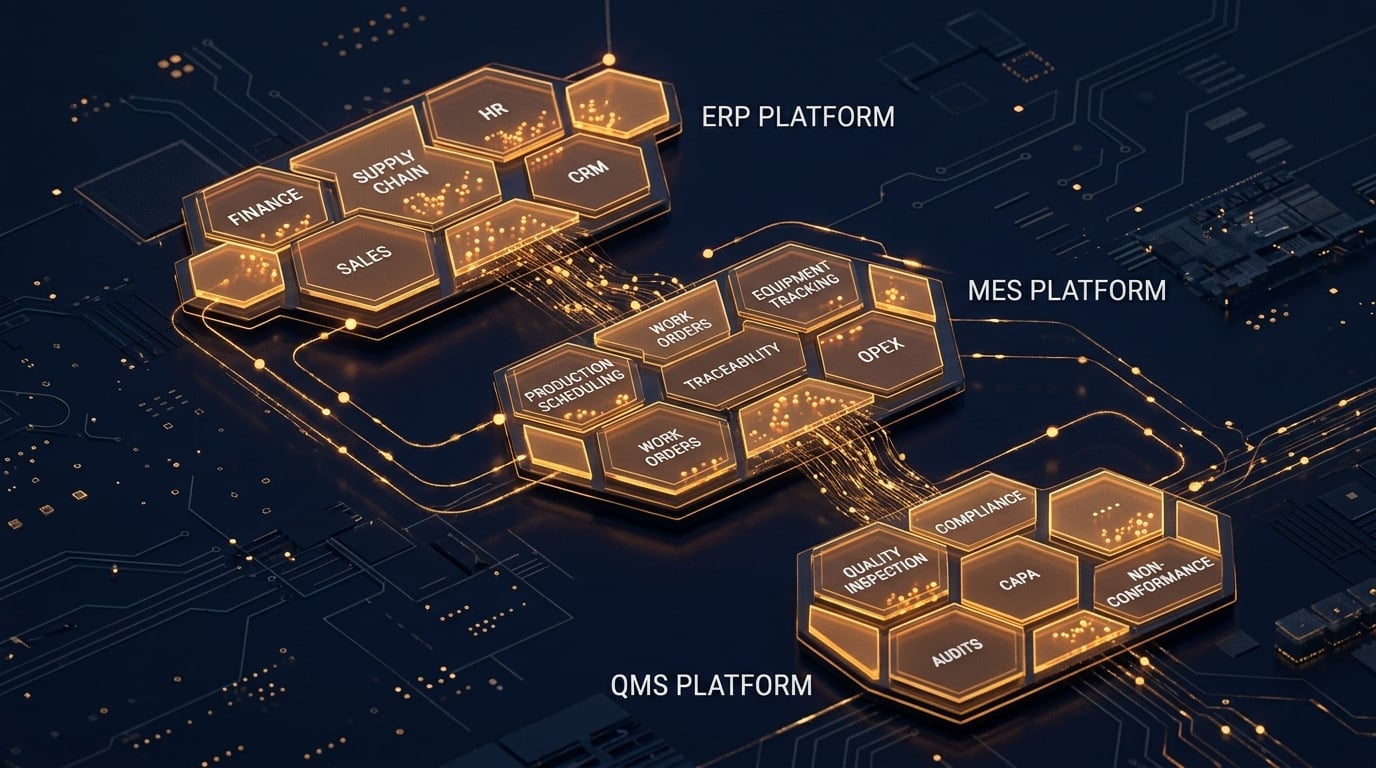
Think of it vertically: ERP is the top floor (business), MES is the shop floor (execution), and QMS is the thread of quality and compliance running through both.
ERP is where orders, materials, costs, and planning live. It is essential — but it is not designed to manage what happens minute-to-minute on a machine. Trying to run real-time shop-floor execution from ERP alone leads to stale data and manual workarounds. If your pain is financial, planning, or inventory-related, ERP is your priority.
MES fills the gap between ERP's plan and the physical reality of production. It captures machine data, tracks work orders in real time, manages operators, and calculates OEE. If your pain is lack of floor visibility, paper tracking, or inability to explain schedule misses, MES is your priority. (See our MES buyer's guide for how to select one.)
A QMS manages inspections, nonconformances, corrective actions, document control, and audit readiness — critical for ISO 9001, AS9100, IATF 16949, and FDA-regulated environments. If your pain is quality escapes, audit stress, or paper-based compliance, QMS is your priority. For quality-system needs specifically, our sister brand ExceleorQMS specializes in exactly this.
The magic happens when these systems integrate rather than operate as islands:
When integrated well, a defect flagged in QMS can be traced to the exact MES work order and the ERP material lot — end-to-end traceability that is impossible with disconnected systems.
There is no universal answer — it depends on where your pain and risk are greatest:
The expensive mistake is choosing based on which vendor called you last. An independent assessment of your operation — not a sales pitch — should drive the decision.
OPZ360 does not resell ERP, MES, or QMS software, so our guidance is genuinely vendor-neutral. Our ERP/MES Selection service helps you prioritize and select the right systems for your operation and budget, with integration planned from day one.
Start with our free Digital Readiness Assessment to clarify your priorities, or contact our team to talk through your specific situation.
The 30-Second Version
- ERP (Enterprise Resource Planning) runs the business: finance, purchasing, inventory, orders, high-level planning. It answers "what should we make and what does it cost?"
- MES (Manufacturing Execution System) runs the production floor: work orders, machine status, real-time tracking, OEE. It answers "what is actually happening in production right now?"
- QMS (Quality Management System) runs quality and compliance: inspections, nonconformances, CAPA, document control, audits. It answers "is what we made good, and can we prove it?"
Think of it vertically: ERP is the top floor (business), MES is the shop floor (execution), and QMS is the thread of quality and compliance running through both.
ERP: The Business Backbone
ERP is where orders, materials, costs, and planning live. It is essential — but it is not designed to manage what happens minute-to-minute on a machine. Trying to run real-time shop-floor execution from ERP alone leads to stale data and manual workarounds. If your pain is financial, planning, or inventory-related, ERP is your priority.
MES: The Real-Time Execution Layer
MES fills the gap between ERP's plan and the physical reality of production. It captures machine data, tracks work orders in real time, manages operators, and calculates OEE. If your pain is lack of floor visibility, paper tracking, or inability to explain schedule misses, MES is your priority. (See our MES buyer's guide for how to select one.)
QMS: The Compliance and Quality Thread
A QMS manages inspections, nonconformances, corrective actions, document control, and audit readiness — critical for ISO 9001, AS9100, IATF 16949, and FDA-regulated environments. If your pain is quality escapes, audit stress, or paper-based compliance, QMS is your priority. For quality-system needs specifically, our sister brand ExceleorQMS specializes in exactly this.
How They Fit Together
The magic happens when these systems integrate rather than operate as islands:
- ERP sends the production plan and orders down to MES.
- MES executes and feeds real-time progress, costs, and completion back up to ERP.
- QMS captures quality data at the point of production (often via MES) and links defects to specific lots, machines, and operators for traceability.
When integrated well, a defect flagged in QMS can be traced to the exact MES work order and the ERP material lot — end-to-end traceability that is impossible with disconnected systems.
Which One First?
There is no universal answer — it depends on where your pain and risk are greatest:
- Bleeding money on planning/costing chaos? Fix ERP first.
- Flying blind on the floor? Prioritize MES.
- Failing audits or shipping defects? Prioritize QMS.
The expensive mistake is choosing based on which vendor called you last. An independent assessment of your operation — not a sales pitch — should drive the decision.
Get an Independent Recommendation
OPZ360 does not resell ERP, MES, or QMS software, so our guidance is genuinely vendor-neutral. Our ERP/MES Selection service helps you prioritize and select the right systems for your operation and budget, with integration planned from day one.
Start with our free Digital Readiness Assessment to clarify your priorities, or contact our team to talk through your specific situation.