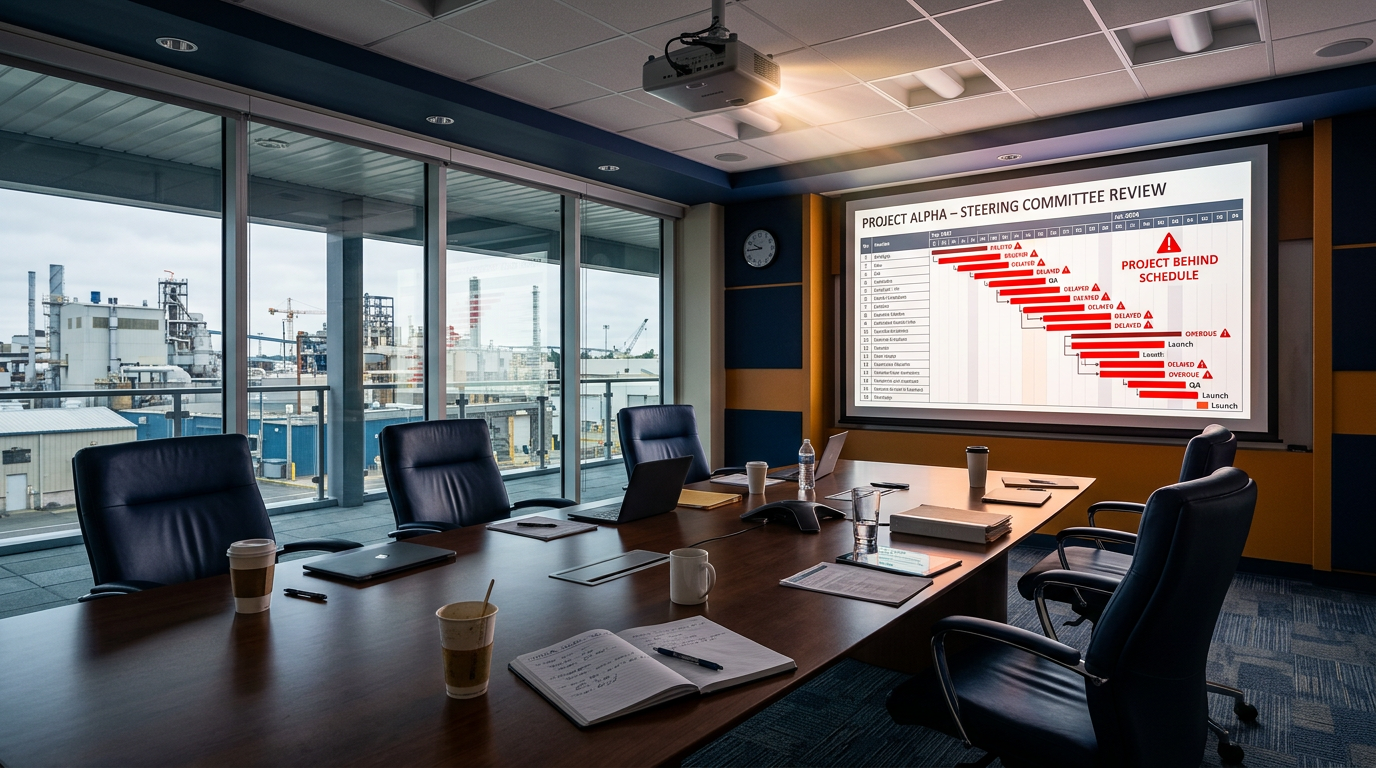
The go-live date has already moved once. The status report still says green. The implementation partner is confident. And yet, in the hallway after the steering meeting, the people closest to the work are quietly saying what nobody says in the room: this is going to slip again.
ERP implementations rarely fail all at once. They drift, one reasonable delay at a time, until the plant is living in a permanent state of "almost ready."
The project has momentum and meetings, but the finish line keeps moving. Data migration is "nearly done." Testing keeps finding issues that need "just one more" configuration change. Key users are stretched between their day jobs and the project. Leadership is getting uneasy, but every individual delay has a plausible explanation.
Meanwhile, the old system is being kept alive past its planned retirement, and the team is exhausted.
Status reporting measures activity, not readiness. Tasks completed look like progress. Whether the business can actually run on the new system is a different question — and often not the one being reported.
Scope creeps quietly. Every department adds "one small thing." Individually reasonable, collectively they can double the work.
Data is harder than anyone planned. Legacy data is almost always messier than expected. Migration exposes years of inconsistent part numbers, duplicate customers and undocumented practices.
Key users are overloaded. The people who know the processes best are also the people keeping the plant running. The project gets whatever time is left over.
Nobody wants to deliver bad news. Partners want to protect the relationship. Internal teams do not want to look like the reason for delay. So risks are softened until they become facts.
Every month of delay extends partner fees, internal effort and the cost of running two systems. It drains your best people. It erodes trust in the project and the leadership sponsoring it. And the pressure to finally go live creates its own risk: plants that go live before they are ready often face disrupted shipments, inventory chaos and months of recovery that cost far more than a well-managed delay.
"Green status means we are on track." Green status means tasks are being completed. Only honest readiness measures tell you whether the business can operate on the system.
"We just need to push harder." If the causes are scope, data or capacity, pushing harder usually produces a worse go-live, not a faster one.
"The partner is responsible for the timeline." Partners own their deliverables. The business owns its decisions, its data and its readiness.
Healthy implementations have honest, readiness-based reporting, controlled scope with every change recorded and approved, key users with protected time, and a go-live decision based on evidence rather than a calendar. When the date does move, the reason is clear and the new plan is credible.
If the project is in trouble, an independent view is often the fastest route to clarity. Our sister brand Exceleor brings that foundation-first perspective across the ecosystem. Related: the stalled project with no scope, budget or owner, why ERP systems end up half used, and our change management service.
If your go-live keeps sliding, read the ERP go-live situation, then tell us what's going on. We will reply from [email protected].
ERP implementations rarely fail all at once. They drift, one reasonable delay at a time, until the plant is living in a permanent state of "almost ready."
What This Situation Actually Looks Like
The project has momentum and meetings, but the finish line keeps moving. Data migration is "nearly done." Testing keeps finding issues that need "just one more" configuration change. Key users are stretched between their day jobs and the project. Leadership is getting uneasy, but every individual delay has a plausible explanation.
Meanwhile, the old system is being kept alive past its planned retirement, and the team is exhausted.
Why It Happens
Status reporting measures activity, not readiness. Tasks completed look like progress. Whether the business can actually run on the new system is a different question — and often not the one being reported.
Scope creeps quietly. Every department adds "one small thing." Individually reasonable, collectively they can double the work.
Data is harder than anyone planned. Legacy data is almost always messier than expected. Migration exposes years of inconsistent part numbers, duplicate customers and undocumented practices.
Key users are overloaded. The people who know the processes best are also the people keeping the plant running. The project gets whatever time is left over.
Nobody wants to deliver bad news. Partners want to protect the relationship. Internal teams do not want to look like the reason for delay. So risks are softened until they become facts.
Warning Signs
- The go-live date has moved and the root cause was never clearly stated.
- Status is green, but the people doing the work are not confident.
- Data migration keeps being reported as "almost done."
- Testing is compressed to protect the date.
- Key users have not been released from their day jobs.
- The change log is growing faster than items are closing.
- Nobody has described what "ready" looks like from the floor's point of view.
What Delay Costs
Every month of delay extends partner fees, internal effort and the cost of running two systems. It drains your best people. It erodes trust in the project and the leadership sponsoring it. And the pressure to finally go live creates its own risk: plants that go live before they are ready often face disrupted shipments, inventory chaos and months of recovery that cost far more than a well-managed delay.
Common Misconceptions
"Green status means we are on track." Green status means tasks are being completed. Only honest readiness measures tell you whether the business can operate on the system.
"We just need to push harder." If the causes are scope, data or capacity, pushing harder usually produces a worse go-live, not a faster one.
"The partner is responsible for the timeline." Partners own their deliverables. The business owns its decisions, its data and its readiness.
Questions Leaders Should Be Asking
- What is the real reason the date moved last time?
- How do we define "ready," and who on the floor signs off on it?
- How clean is our migrated data, measured, not estimated?
- How much scope has been added since the project was approved?
- Are our key users actually available to the project?
- Would we rather go live on time, or go live successfully?
What Good Looks Like
Healthy implementations have honest, readiness-based reporting, controlled scope with every change recorded and approved, key users with protected time, and a go-live decision based on evidence rather than a calendar. When the date does move, the reason is clear and the new plan is credible.
If the project is in trouble, an independent view is often the fastest route to clarity. Our sister brand Exceleor brings that foundation-first perspective across the ecosystem. Related: the stalled project with no scope, budget or owner, why ERP systems end up half used, and our change management service.
Frequently Asked Questions
What are the early warning signs of an ERP implementation in trouble?
A go-live date that has moved without a clear root cause, green status reports alongside low team confidence, migration stuck at "almost done," compressed testing and overloaded key users.
Why do ERP projects fall behind schedule?
Common causes include quiet scope creep, harder-than-expected data migration, key users without protected time and status reporting that tracks activity rather than readiness.
Is it better to delay go-live or push through?
A go-live before the business is ready often costs far more in disruption than a well-managed delay. The decision should be based on readiness evidence, not the calendar.
Who is responsible when an ERP project slips?
The partner owns its deliverables, but the business owns its decisions, data quality, user availability and readiness. Recovery requires both.
Tell Us What's Going On
If your go-live keeps sliding, read the ERP go-live situation, then tell us what's going on. We will reply from [email protected].