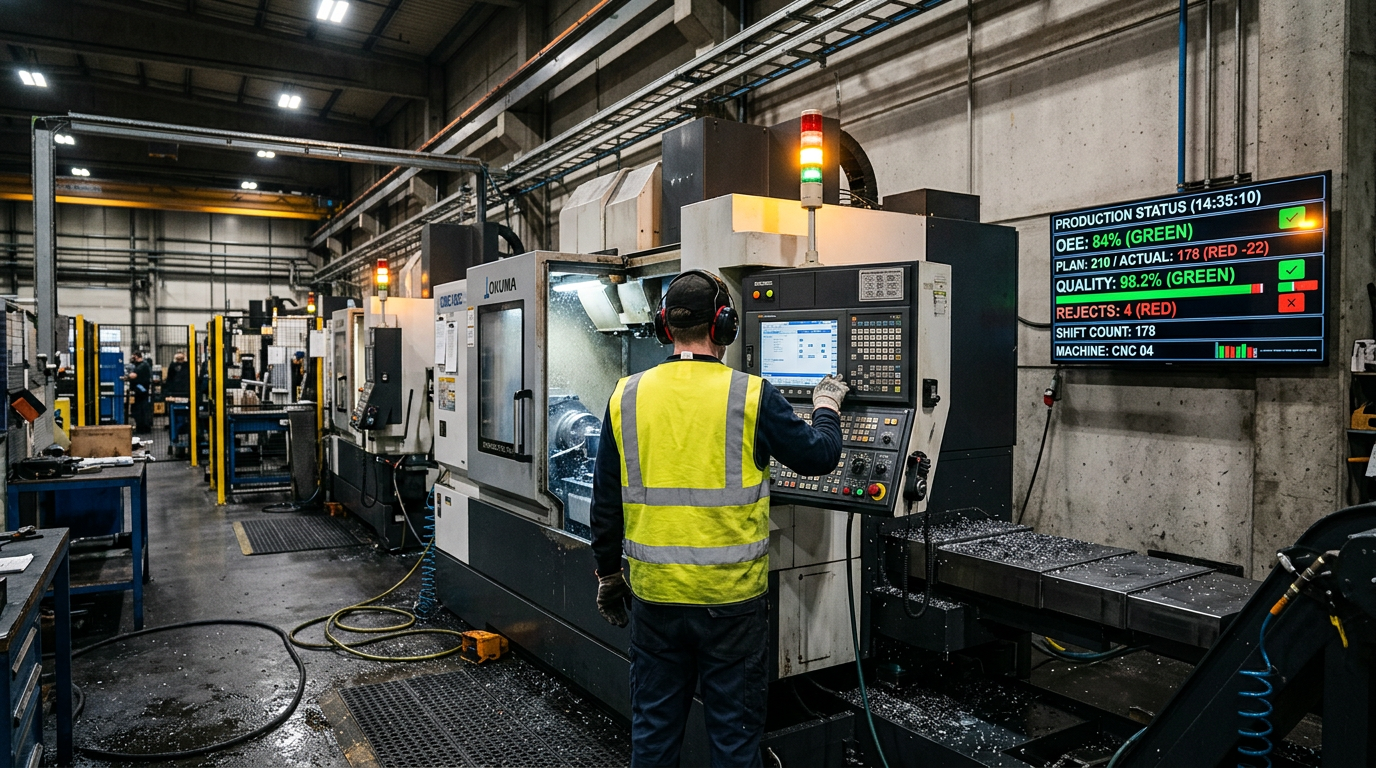
The OEE number on the report looks respectable. Maybe it is even improving. And yet the plant is still missing shipments, still running weekend overtime, still explaining to customers why the order is late. Somewhere between the metric and the loading dock, output is disappearing.
When OEE says one thing and the customer says another, believe the customer — and start asking what the number is not showing you.
The weekly review shows OEE in a reasonable range. Individual machines look healthy. But total output falls short of plan, expediting is constant, and supervisors describe a very different day than the report does. Everyone is working hard, the metric says the equipment is performing, and the plant still cannot hit its numbers.
The definition flatters the result. OEE depends on what counts as planned time, what counts as the ideal rate, and which stops are excluded. Small, well-intentioned choices — excluding changeovers, using a conservative ideal rate, not counting short stops — can make the number look much better than reality.
You are measuring the wrong machines. OEE on a non-constraint machine can be excellent while the real bottleneck starves the line. High OEE in the wrong place does not ship parts.
Losses are happening between machines. Waiting for material, quality holds, rework loops, staffing gaps and scheduling problems often do not show up in equipment-level OEE at all.
The data is manual. When downtime reasons and counts are recorded by hand at the end of the shift, short stops disappear and causes get rounded into "other."
The metric became the goal. Once OEE is a target people are judged on, there is pressure — conscious or not — to make the number look good rather than make the plant perform.
The most expensive part is misdirected effort. If the metric points to the wrong problem, improvement work goes to the wrong place — and the real loss keeps costing you every shift. Add overtime, expediting, late-delivery penalties and customer patience, and a misleading OEE number can be one of the costliest measures in the building.
"Higher OEE always means more output." Only on the constraint. Improving a non-bottleneck machine often just builds inventory in front of the real limit.
"OEE is a standard number." The formula is standard; the inputs are not. Two plants reporting the same OEE may be measuring very different things.
"We need automated OEE software." Automation helps with accuracy, but automating a flawed definition just produces a flawed number faster.
In plants where OEE is genuinely useful, the definition is honest and consistent, the constraint is known and closely watched, losses between machines are visible, and the number matches what people experience on the floor. OEE is used to find problems, not to grade people.
That way of seeing loss is rooted in lean thinking, which our sister brand QMSLean specializes in. Related: why dashboards don't change decisions, machines that fail without warning, and our data analytics service.
If your OEE and your shipments tell different stories, read the OEE situation, then tell us what's going on. We will reply from [email protected].
When OEE says one thing and the customer says another, believe the customer — and start asking what the number is not showing you.
What This Situation Actually Looks Like
The weekly review shows OEE in a reasonable range. Individual machines look healthy. But total output falls short of plan, expediting is constant, and supervisors describe a very different day than the report does. Everyone is working hard, the metric says the equipment is performing, and the plant still cannot hit its numbers.
Why It Happens
The definition flatters the result. OEE depends on what counts as planned time, what counts as the ideal rate, and which stops are excluded. Small, well-intentioned choices — excluding changeovers, using a conservative ideal rate, not counting short stops — can make the number look much better than reality.
You are measuring the wrong machines. OEE on a non-constraint machine can be excellent while the real bottleneck starves the line. High OEE in the wrong place does not ship parts.
Losses are happening between machines. Waiting for material, quality holds, rework loops, staffing gaps and scheduling problems often do not show up in equipment-level OEE at all.
The data is manual. When downtime reasons and counts are recorded by hand at the end of the shift, short stops disappear and causes get rounded into "other."
The metric became the goal. Once OEE is a target people are judged on, there is pressure — conscious or not — to make the number look good rather than make the plant perform.
Warning Signs
- OEE is stable or improving while on-time delivery is not.
- Supervisors' descriptions of the shift do not match the report.
- "Other" or "unassigned" is one of the largest downtime categories.
- Nobody is sure which machine is the real constraint.
- Changeovers or short stops are excluded from the calculation.
- Different lines or sites calculate OEE differently.
What It's Costing You
The most expensive part is misdirected effort. If the metric points to the wrong problem, improvement work goes to the wrong place — and the real loss keeps costing you every shift. Add overtime, expediting, late-delivery penalties and customer patience, and a misleading OEE number can be one of the costliest measures in the building.
Common Misconceptions
"Higher OEE always means more output." Only on the constraint. Improving a non-bottleneck machine often just builds inventory in front of the real limit.
"OEE is a standard number." The formula is standard; the inputs are not. Two plants reporting the same OEE may be measuring very different things.
"We need automated OEE software." Automation helps with accuracy, but automating a flawed definition just produces a flawed number faster.
Questions Leaders Should Be Asking
- How exactly is our OEE defined, and what is excluded?
- Which machine or process is actually limiting our output?
- What is OEE on that constraint specifically?
- How much loss happens between machines rather than on them?
- Do supervisors believe the number?
- Are we managing the plant or managing the metric?
What Good Looks Like
In plants where OEE is genuinely useful, the definition is honest and consistent, the constraint is known and closely watched, losses between machines are visible, and the number matches what people experience on the floor. OEE is used to find problems, not to grade people.
That way of seeing loss is rooted in lean thinking, which our sister brand QMSLean specializes in. Related: why dashboards don't change decisions, machines that fail without warning, and our data analytics service.
Frequently Asked Questions
Why is our OEE good but output still low?
Common reasons include flattering definitions that exclude certain losses, measuring non-constraint machines, losses that happen between machines, and manually recorded data that misses short stops.
Is OEE calculated the same way everywhere?
The formula is standard, but inputs such as planned time, ideal rate and excluded stops vary widely, so OEE values are often not comparable.
Where should OEE be measured?
It is most meaningful on the constraint — the process that limits total output. High OEE elsewhere may not increase shipments.
Can OEE be misleading?
Yes, especially when it becomes a target people are judged on, or when definitions exclude losses that matter to the customer.
Tell Us What's Going On
If your OEE and your shipments tell different stories, read the OEE situation, then tell us what's going on. We will reply from [email protected].