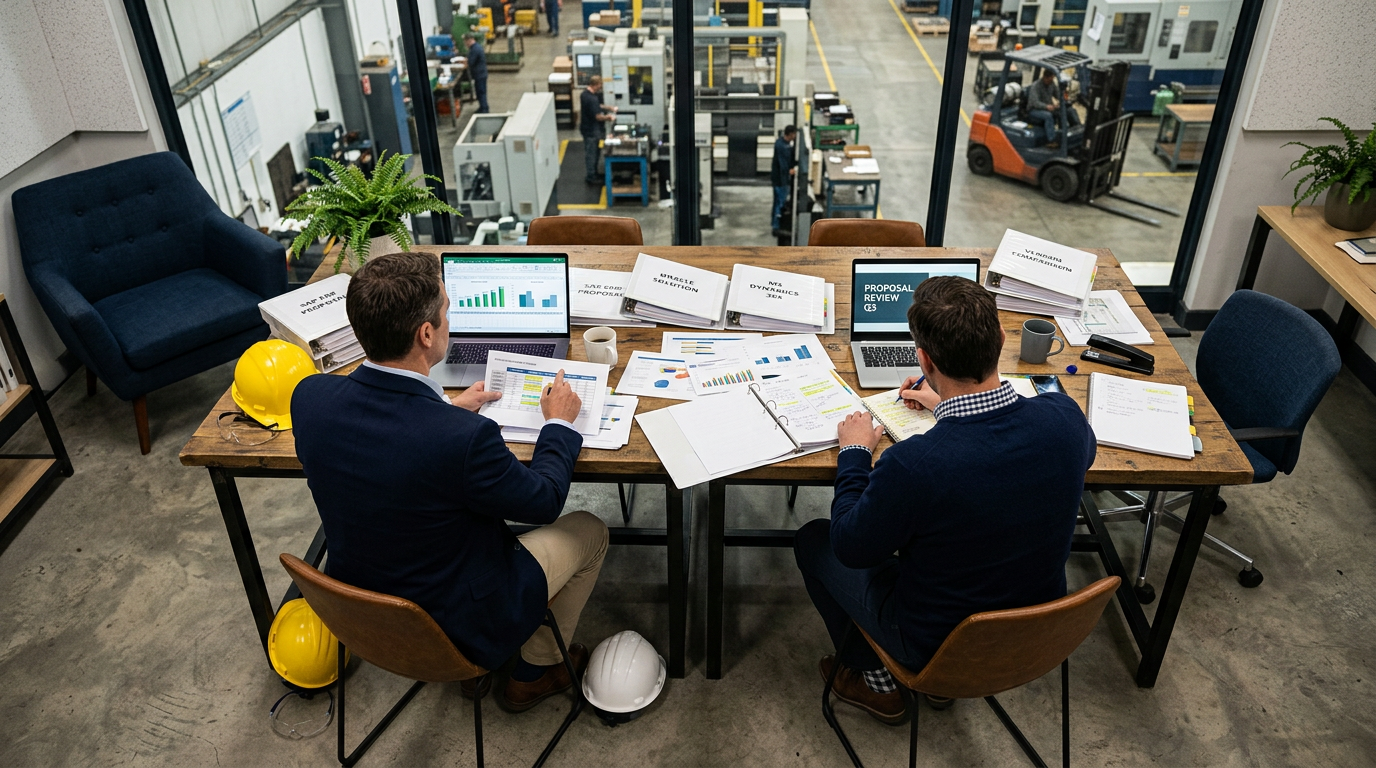
You started out selecting a system. Somewhere along the way, the system started selecting you. The demo calendar is full. One vendor helpfully shared an RFP template. Another has a "free assessment" that happens to conclude you need their product. Every presentation is polished, and every one frames your needs a little differently.
If you have the uneasy sense that the people selling to you are running your process, you are probably right.
The shortlist came from whoever reached out first, an analyst quadrant, or a peer's recommendation. Requirements exist, but they read like a feature list — and suspiciously like the brochure of whichever vendor helped write them. Demos follow each vendor's script, so comparisons are apples to oranges. Internally, different departments have favorites for different reasons, and the decision is drifting toward whoever presents best on the final day.
Vendors are better at selling than most plants are at buying. They do this every week. You do it once a decade. That asymmetry is natural, and it shows.
Requirements start with features, not outcomes. "Must have real-time dashboards" is a feature. "Supervisors must know within minutes when a line falls behind plan" is an outcome. Feature lists are easy for any vendor to check off.
The process underneath is not defined. If you have not agreed on how you want to run production scheduling, quality holds or inventory, each vendor will happily show you theirs. You end up choosing a process by choosing a product.
Time pressure. An existing system is going end-of-life, a contract is expiring, or leadership wants a decision by quarter end. Pressure hands control to whoever offers the fastest path to signing.
The license is often the smallest number. The true cost shows up in implementation, customization, and years of working around a system designed for someone else's process. Plants that let vendors lead often end up with heavy customization to force a fit, or with a floor that runs the real process on spreadsheets beside the new system.
The switching cost is enormous. MES and ERP decisions are among the stickiest a manufacturer makes. A poor choice is not a one-year mistake; it is often a decade.
"The market leader is the safe choice." Market leaders are safe for vendors' shareholders. Whether they fit your process, size and team is a separate question.
"We can configure it to work how we work." Sometimes. Often it means customization that complicates every future upgrade.
"The implementation partner will sort out the details." Implementation partners implement what you decided. If the decision was wrong, they implement it very efficiently.
Well-run selections look almost dull from the outside. Outcomes are defined before features. Vendors respond to your scenarios, using your data where possible. Total cost of ownership is compared honestly. The floor has a voice. And the final decision can be explained in terms of business fit, not presentation quality.
Our vendor-neutral ERP/MES selection service exists for exactly this, and our MES buyer's overview and ERP vs MES vs QMS give context. If the bigger issue is organizational decision-making, our sister brand ConsultFactor focuses on that.
If your selection feels like it is running you, read the vendor-led selection situation, then tell us what's going on. We will reply from [email protected].
If you have the uneasy sense that the people selling to you are running your process, you are probably right.
What This Situation Actually Looks Like
The shortlist came from whoever reached out first, an analyst quadrant, or a peer's recommendation. Requirements exist, but they read like a feature list — and suspiciously like the brochure of whichever vendor helped write them. Demos follow each vendor's script, so comparisons are apples to oranges. Internally, different departments have favorites for different reasons, and the decision is drifting toward whoever presents best on the final day.
Why It Happens
Vendors are better at selling than most plants are at buying. They do this every week. You do it once a decade. That asymmetry is natural, and it shows.
Requirements start with features, not outcomes. "Must have real-time dashboards" is a feature. "Supervisors must know within minutes when a line falls behind plan" is an outcome. Feature lists are easy for any vendor to check off.
The process underneath is not defined. If you have not agreed on how you want to run production scheduling, quality holds or inventory, each vendor will happily show you theirs. You end up choosing a process by choosing a product.
Time pressure. An existing system is going end-of-life, a contract is expiring, or leadership wants a decision by quarter end. Pressure hands control to whoever offers the fastest path to signing.
Warning Signs
- Your requirements document came from, or was heavily edited by, a vendor.
- Every demo followed the vendor's script instead of your scenarios.
- You cannot explain how finalists differ except by look and feel.
- Implementation cost and internal effort have not been discussed seriously.
- References were all supplied by vendors.
- The floor has not seen the systems.
What a Vendor-Led Decision Costs
The license is often the smallest number. The true cost shows up in implementation, customization, and years of working around a system designed for someone else's process. Plants that let vendors lead often end up with heavy customization to force a fit, or with a floor that runs the real process on spreadsheets beside the new system.
The switching cost is enormous. MES and ERP decisions are among the stickiest a manufacturer makes. A poor choice is not a one-year mistake; it is often a decade.
Common Misconceptions
"The market leader is the safe choice." Market leaders are safe for vendors' shareholders. Whether they fit your process, size and team is a separate question.
"We can configure it to work how we work." Sometimes. Often it means customization that complicates every future upgrade.
"The implementation partner will sort out the details." Implementation partners implement what you decided. If the decision was wrong, they implement it very efficiently.
Questions Leaders Should Be Asking
- Have we defined how we want our core processes to work before looking at systems?
- Are the demos proving our scenarios, or the vendor's?
- What is the total cost over several years, including our own people's time?
- Who, internally, owns this decision and its outcome?
- Have we spoken to customers the vendor did not hand-pick?
- Is anyone advising us who does not benefit from the choice?
What Good Looks Like
Well-run selections look almost dull from the outside. Outcomes are defined before features. Vendors respond to your scenarios, using your data where possible. Total cost of ownership is compared honestly. The floor has a voice. And the final decision can be explained in terms of business fit, not presentation quality.
Our vendor-neutral ERP/MES selection service exists for exactly this, and our MES buyer's overview and ERP vs MES vs QMS give context. If the bigger issue is organizational decision-making, our sister brand ConsultFactor focuses on that.
Frequently Asked Questions
How can we tell if a vendor is driving our MES or ERP selection?
Signs include vendor-authored requirements, demos that follow the vendor's script, vendor-supplied references only, and finalists you can only distinguish by presentation quality.
Is it bad to accept a vendor's RFP template?
It is risky. A template written by a vendor naturally emphasizes what that vendor does well and may miss what your operation actually needs.
What is the biggest hidden cost in ERP or MES selection?
Implementation effort, customization and years of workarounds when the system does not fit the process — often far larger than the license itself.
Why use a vendor-neutral advisor?
Because everyone else in the process benefits from a particular outcome. A neutral advisor's only interest is whether the system fits your operation.
Tell Us What's Going On
If your selection feels like it is running you, read the vendor-led selection situation, then tell us what's going on. We will reply from [email protected].