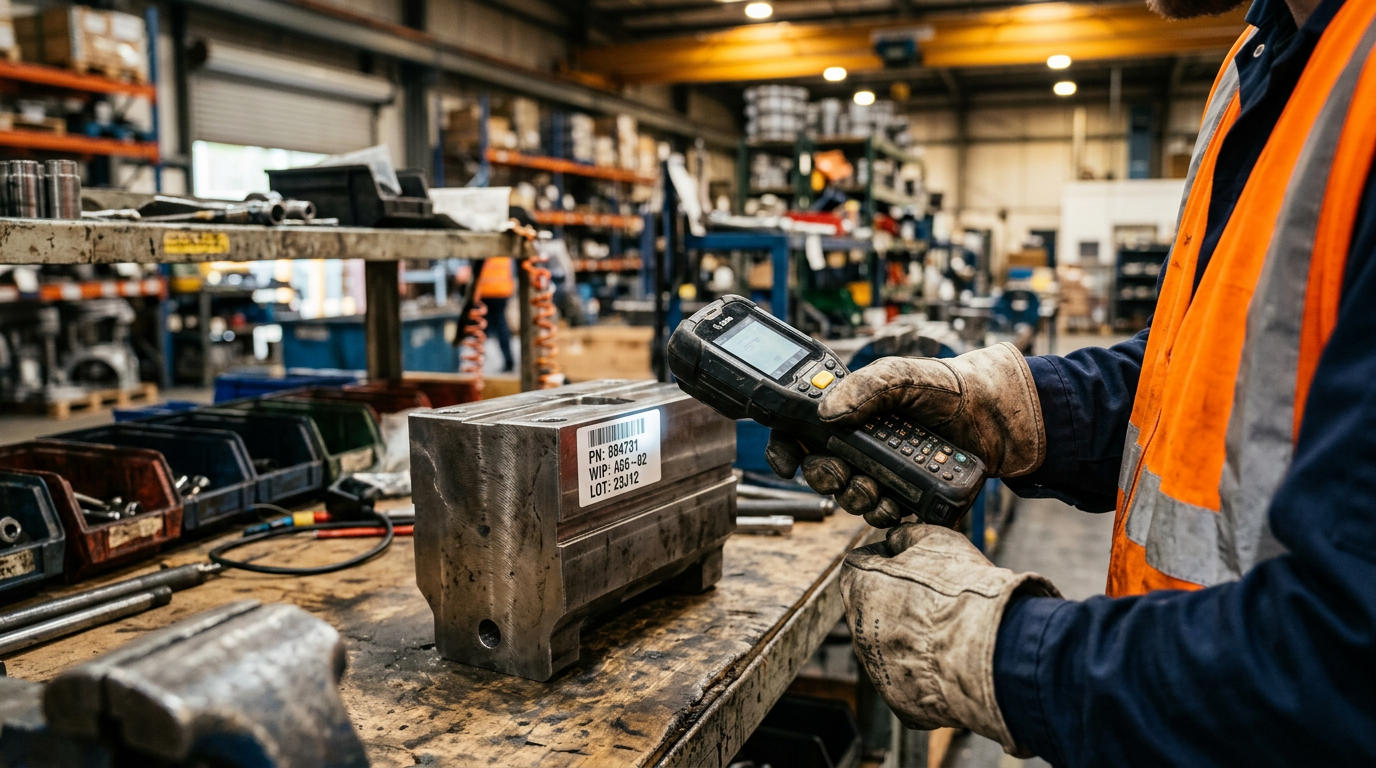
On paper, barcode scanning is the easiest win in manufacturing. Inventory is off, traceability is manual, and somebody is still keying part numbers from a clipboard into the ERP at the end of the shift. Everyone agrees scanning would help. And yet, months later, the scanners are still in a box — or worse, they are on the floor and nobody trusts what they record.
If you are stuck somewhere between "we should scan" and "we are scanning," you are in very common company.
The symptoms are familiar. Cycle counts never match the system. Material shows as available when it is not. A customer asks for lot traceability and it takes two people and an afternoon to piece together. The shop floor writes things down, the office types them in, and the errors live in the gap between the two.
The barcode project was supposed to close that gap. Instead it has turned into an endless loop of label format discussions, hardware quotes, ERP questions and a pilot that never quite ends.
Scanning exposes the process underneath. A barcode records what happens. If what happens is inconsistent — material moved without a transaction, locations that exist only in someone's head, part numbers with three aliases — the scanner does not fix that. It makes it visible. Many projects stall at exactly the moment the process problems surface.
It sits between departments. Warehouse, production, quality, IT and purchasing all touch it. Each has a different idea of what "done" means. Without one owner, every decision gets escalated or deferred.
The ERP question is bigger than expected. What transactions does the system actually support? Which ones are configured? Who can change them? Many plants discover mid-project that the ERP was never set up to receive what the scanners want to send.
The hardware conversation comes first. Devices are tangible and easy to quote. So the project starts there — and the harder questions about data, locations and workflow are deferred until after the purchase.
Every month without reliable scanning means more expediting for parts the system said you had, more physical counts, more write-offs, and more exposure when a customer or auditor asks where a lot went. It also costs credibility. When a scanning rollout stumbles, the floor concludes that the system is the problem, and the workarounds get more entrenched.
In regulated or customer-audited environments, weak traceability is not just an efficiency issue. It can become a finding, a lost customer, or a recall that is far larger than it needed to be.
"It is a hardware project." The hardware is the smallest part. The real work is agreeing on what gets recorded, where, by whom, and what the system does with it.
"Scanning will fix inventory accuracy." Scanning records movements accurately. If movements happen outside the process, accuracy does not improve.
"We will sort out the process after go-live." After go-live, the process is whatever people do to get around the system.
In plants where scanning works, it is boring. Operators scan because it is faster than writing. The system reflects reality closely enough that nobody keeps a shadow spreadsheet. Traceability questions take minutes, not afternoons. And there is a clear owner who treats inventory accuracy as a business measure, not an IT ticket.
The path to that point is rarely about the scanner. It is about the foundation underneath. For the upstream side of the chain — suppliers, sourcing and the material data you receive before it ever hits your dock — our sister brand SupplySourceSync works on exactly that. You may also find our piece on first IoT projects and ERP vs MES vs QMS useful context.
If your scanning project is stuck, the reason is usually specific and fixable. Read the barcode scanning situation, then tell us what's going on. We will reply from [email protected].
If you are stuck somewhere between "we should scan" and "we are scanning," you are in very common company.
What This Situation Actually Looks Like
The symptoms are familiar. Cycle counts never match the system. Material shows as available when it is not. A customer asks for lot traceability and it takes two people and an afternoon to piece together. The shop floor writes things down, the office types them in, and the errors live in the gap between the two.
The barcode project was supposed to close that gap. Instead it has turned into an endless loop of label format discussions, hardware quotes, ERP questions and a pilot that never quite ends.
Why It Happens
Scanning exposes the process underneath. A barcode records what happens. If what happens is inconsistent — material moved without a transaction, locations that exist only in someone's head, part numbers with three aliases — the scanner does not fix that. It makes it visible. Many projects stall at exactly the moment the process problems surface.
It sits between departments. Warehouse, production, quality, IT and purchasing all touch it. Each has a different idea of what "done" means. Without one owner, every decision gets escalated or deferred.
The ERP question is bigger than expected. What transactions does the system actually support? Which ones are configured? Who can change them? Many plants discover mid-project that the ERP was never set up to receive what the scanners want to send.
The hardware conversation comes first. Devices are tangible and easy to quote. So the project starts there — and the harder questions about data, locations and workflow are deferred until after the purchase.
Warning Signs
- The pilot has been "almost done" for months.
- There is disagreement about what a label should contain.
- Nobody can list every location material actually sits in.
- Operators scan, but also still write it down "just in case."
- Inventory accuracy has not improved since scanning started.
- IT and operations each think the other owns the next step.
What the Delay Costs
Every month without reliable scanning means more expediting for parts the system said you had, more physical counts, more write-offs, and more exposure when a customer or auditor asks where a lot went. It also costs credibility. When a scanning rollout stumbles, the floor concludes that the system is the problem, and the workarounds get more entrenched.
In regulated or customer-audited environments, weak traceability is not just an efficiency issue. It can become a finding, a lost customer, or a recall that is far larger than it needed to be.
Common Misconceptions
"It is a hardware project." The hardware is the smallest part. The real work is agreeing on what gets recorded, where, by whom, and what the system does with it.
"Scanning will fix inventory accuracy." Scanning records movements accurately. If movements happen outside the process, accuracy does not improve.
"We will sort out the process after go-live." After go-live, the process is whatever people do to get around the system.
Questions Leaders Should Be Asking
- What decision will be better once we trust the scan data?
- Do we actually know every place material is stored and moved?
- Is our ERP configured to receive the transactions we want to capture?
- Who owns the outcome across warehouse, production and quality?
- What is the real reason the pilot has not finished?
What Good Looks Like
In plants where scanning works, it is boring. Operators scan because it is faster than writing. The system reflects reality closely enough that nobody keeps a shadow spreadsheet. Traceability questions take minutes, not afternoons. And there is a clear owner who treats inventory accuracy as a business measure, not an IT ticket.
The path to that point is rarely about the scanner. It is about the foundation underneath. For the upstream side of the chain — suppliers, sourcing and the material data you receive before it ever hits your dock — our sister brand SupplySourceSync works on exactly that. You may also find our piece on first IoT projects and ERP vs MES vs QMS useful context.
Frequently Asked Questions
Why do barcode scanning projects stall in manufacturing?
Most stall because scanning exposes inconsistent processes, unclear locations and ERP configuration gaps — and nobody owns the decisions that span warehouse, production, quality and IT.
Will barcode scanning automatically improve inventory accuracy?
Not on its own. Scanning records transactions accurately, but if material moves outside the process, the system still drifts from reality.
Is choosing the right scanner the most important decision?
Rarely. Hardware is the easiest part to change. The decisions about data, locations, workflow and ERP transactions matter far more.
How do we know our pilot is in trouble?
If it has no clear finish line, operators still keep paper records, or accuracy has not improved since scanning began, the pilot is likely stuck on underlying process issues.
Tell Us What's Going On
If your scanning project is stuck, the reason is usually specific and fixable. Read the barcode scanning situation, then tell us what's going on. We will reply from [email protected].