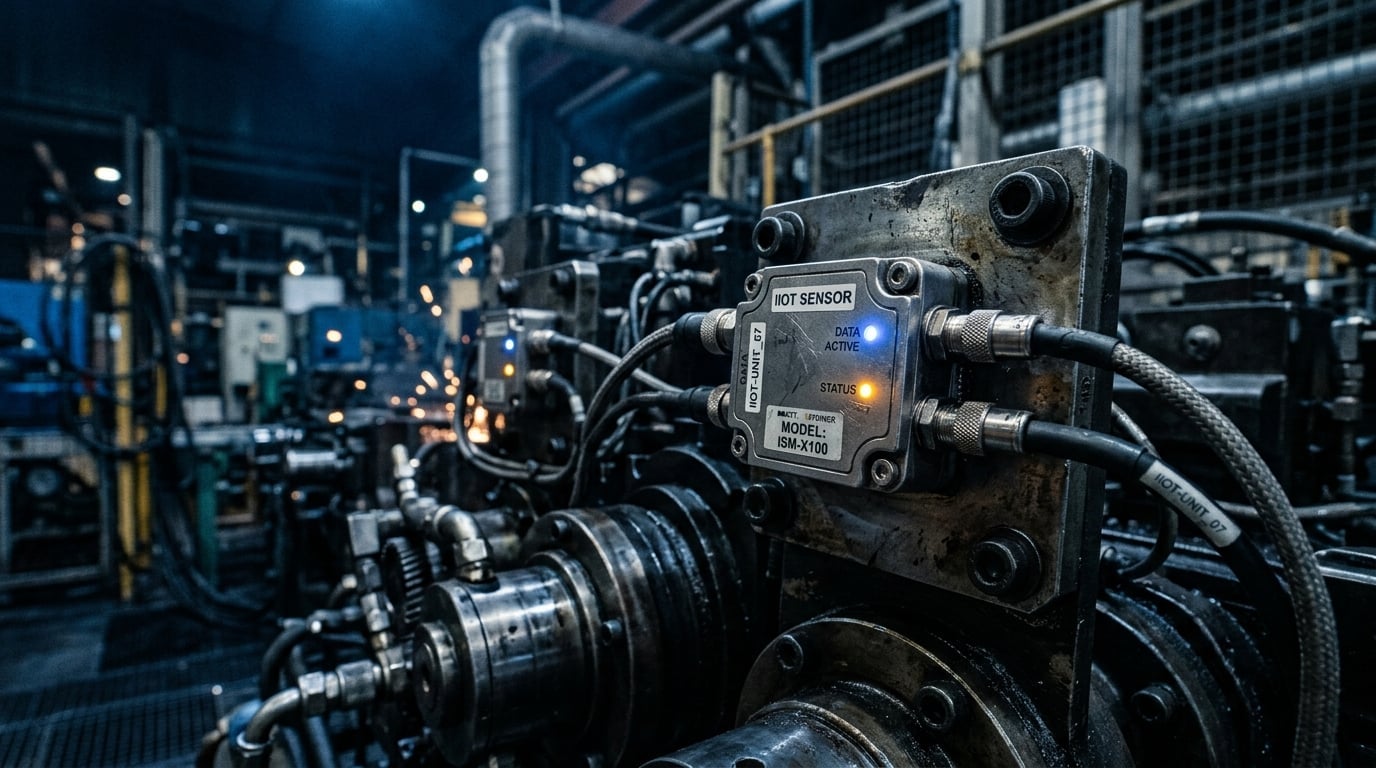
Industrial IoT is where most manufacturers get their first real Industry 4.0 win — because sensors are relatively cheap, quick to deploy, and produce visible results fast. The problem is that many companies try to "connect everything" at once, blow the budget, and end up with data nobody uses. This guide shows you how to start small and win.
The worst IoT projects start with "let's put sensors everywhere and see what we learn." The best ones start with a specific, painful, measurable problem:
Each of these is a perfect first IoT project because success is obvious and measurable.
Most high-ROI first projects use one of these sensor types:
Vibration: The single best early-warning signal for rotating equipment (motors, pumps, spindles, gearboxes). Rising vibration predicts bearing and alignment failures weeks in advance.
Temperature: Overheating precedes many failures and quality issues. Cheap and easy to deploy.
Power / current draw: Reveals machine state (running, idle, starved), energy waste, and load anomalies — often without touching the machine's controls.
Cycle counts and machine state: The foundation of automated OEE. Simple to capture, enormously valuable for eliminating the guesswork in downtime tracking.
Weeks 1–2 — Scope and baseline. Pick ONE bottleneck or problem machine. Document current performance (downtime hours, failure frequency, OEE) so you can prove improvement later.
Weeks 3–4 — Deploy sensors. Install non-invasive sensors on the target equipment. Modern wireless sensors often install in hours, not days, with no machine rewiring.
Weeks 5–8 — Collect and visualize. Get the data into a simple dashboard. Even at this stage, teams usually discover surprising issues ("the machine is starved 30% of the time").
Weeks 9–12 — Act and measure. Set up alerts, adjust maintenance, and quantify the savings. Now you have a proven ROI story to justify scaling.
A successful first IoT project does two things: it delivers hard savings, and it builds the internal credibility and data foundation to fund the next phase. That is the entire philosophy behind our IoT Deployment service — practical pilots that prove value in 90 days, then scale.
Curious what a first project could return for your operation? Try our Industry 4.0 ROI Calculator or take the free Digital Readiness Assessment to identify your highest-impact starting point. When you are ready, contact our team to scope your pilot. To connect sensor-driven quality data into a formal quality system, our sister brand ExceleorQMS can help.
The Golden Rule: Start With a Problem, Not a Sensor
The worst IoT projects start with "let's put sensors everywhere and see what we learn." The best ones start with a specific, painful, measurable problem:
- "Machine 7 keeps failing without warning and it is our bottleneck."
- "We have no idea why Line 3's OEE swings 20 points day to day."
- "Our energy bill spiked and we cannot pinpoint the cause."
Each of these is a perfect first IoT project because success is obvious and measurable.
What to Measure First
Most high-ROI first projects use one of these sensor types:
Vibration: The single best early-warning signal for rotating equipment (motors, pumps, spindles, gearboxes). Rising vibration predicts bearing and alignment failures weeks in advance.
Temperature: Overheating precedes many failures and quality issues. Cheap and easy to deploy.
Power / current draw: Reveals machine state (running, idle, starved), energy waste, and load anomalies — often without touching the machine's controls.
Cycle counts and machine state: The foundation of automated OEE. Simple to capture, enormously valuable for eliminating the guesswork in downtime tracking.
The 90-Day First-Project Blueprint
Weeks 1–2 — Scope and baseline. Pick ONE bottleneck or problem machine. Document current performance (downtime hours, failure frequency, OEE) so you can prove improvement later.
Weeks 3–4 — Deploy sensors. Install non-invasive sensors on the target equipment. Modern wireless sensors often install in hours, not days, with no machine rewiring.
Weeks 5–8 — Collect and visualize. Get the data into a simple dashboard. Even at this stage, teams usually discover surprising issues ("the machine is starved 30% of the time").
Weeks 9–12 — Act and measure. Set up alerts, adjust maintenance, and quantify the savings. Now you have a proven ROI story to justify scaling.
Avoid These Early Traps
- Data with no owner: Someone must be responsible for acting on the alerts, or the project dies.
- Boiling the ocean: Ten machines at once means ten times the complexity and no clear win.
- Ignoring connectivity/IT/OT: Plan early for how data gets from the floor to the cloud securely.
- No baseline: If you did not measure "before," you cannot prove "after."
From First Sensor to Smart Factory
A successful first IoT project does two things: it delivers hard savings, and it builds the internal credibility and data foundation to fund the next phase. That is the entire philosophy behind our IoT Deployment service — practical pilots that prove value in 90 days, then scale.
Curious what a first project could return for your operation? Try our Industry 4.0 ROI Calculator or take the free Digital Readiness Assessment to identify your highest-impact starting point. When you are ready, contact our team to scope your pilot. To connect sensor-driven quality data into a formal quality system, our sister brand ExceleorQMS can help.