"Industry 4.0" gets thrown around in every trade show, vendor pitch, and LinkedIn post — usually wrapped in enough buzzwords to make any plant manager tune out. This guide strips away the hype and explains what Industry 4.0 actually is, why it matters for your bottom line, and how to get started without betting the company on a moonshot project.
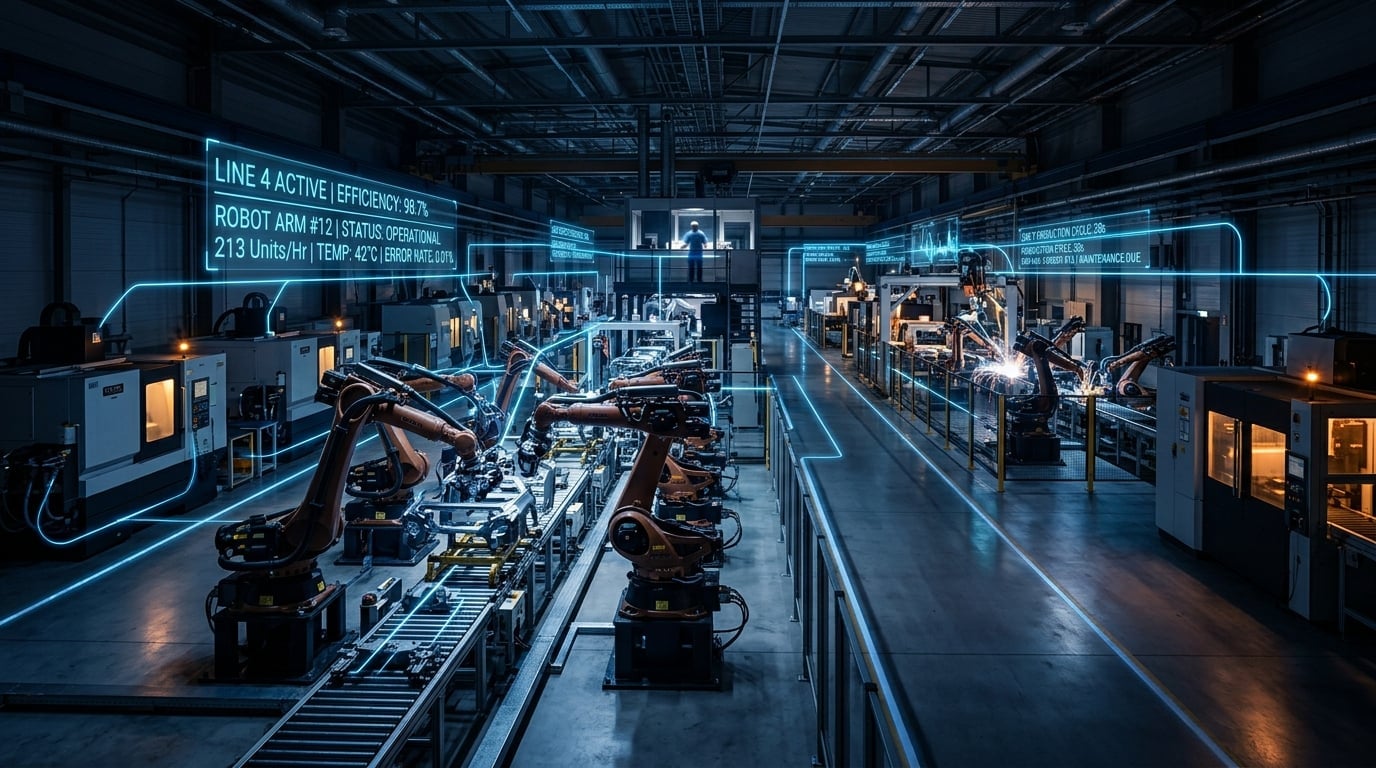
Industry 4.0 is the use of connected data — from machines, sensors, and systems — to make better, faster decisions on the factory floor. That is it. Everything else (IoT, AI, digital twins, cloud) is just a means to that end.
The "4.0" refers to the fourth industrial revolution: steam (1.0), electricity and mass production (2.0), computers and automation (3.0), and now connectivity and data (4.0). The previous three were about doing physical work faster. This one is about doing thinking work faster — turning the flood of data your equipment already produces into action.
Industrial IoT (IIoT): Small sensors attached to machines that measure things like vibration, temperature, energy use, and cycle counts — then send that data somewhere useful. Think of it as giving your equipment a voice.
Data and Analytics: Software that collects sensor and system data and turns it into dashboards, alerts, and trends. This is where raw numbers become "Machine 4 is trending toward failure" or "Line 2 lost 40 minutes to changeovers today."
Automation and Robotics: Not just robot arms — also automated data capture, workflow triggers, and machine-to-machine communication that removes manual steps.
AI and Machine Learning: Algorithms that find patterns humans miss — predicting equipment failures, optimizing schedules, or flagging quality defects before they ship.
Digital Twins: A virtual model of a machine, line, or process that lets you simulate changes before making them physically.
You do not need all of these at once. In fact, trying to is the single most common way transformation projects fail.
There is a myth that Industry 4.0 is only for giant automakers with nine-figure budgets. The opposite is true. Mid-market manufacturers often see the fastest ROI because they are starting from manual processes — which means even basic connectivity delivers huge gains.
Typical outcomes we see when manufacturers adopt Industry 4.0 practically:
Forget the "connect everything" fantasy. The manufacturers who succeed follow a phased approach:
Phase 1 — Assess: Understand your current digital maturity and identify the two or three highest-ROI opportunities. Our free Digital Readiness Assessment takes about 10 minutes and gives you a maturity score plus prioritized recommendations.
Phase 2 — Quick Wins: Pick one high-impact, low-risk project — often IoT sensors on your most troublesome machines or a real-time OEE dashboard. Prove ROI in 90 days.
Phase 3 — Scale: Use the credibility and data from your quick win to fund broader transformation across lines and plants.
This is exactly the model behind our Technology Roadmap and IoT Deployment services — start small, prove value, then scale with confidence.
The biggest mistake manufacturers make is treating Industry 4.0 as a technology purchase. It is not. It is a way of running your operation on data instead of intuition. The technology is the easy part — the hard part is choosing the right problems to solve and managing the change on the floor.
That is where a technology-agnostic partner matters. At OPZ360, we do not sell you software — we help you figure out what actually moves the needle for your operation and ROI. And because we are part of the Exceleor family of operational excellence brands, we can pair your digital transformation with lean process improvement for compounding results.
Want to know where your operation stands? Take the free Digital Readiness Assessment or estimate your ROI with our calculator. Ready to talk specifics? Contact our team.
Industry 4.0 in One Sentence
Industry 4.0 is the use of connected data — from machines, sensors, and systems — to make better, faster decisions on the factory floor. That is it. Everything else (IoT, AI, digital twins, cloud) is just a means to that end.
The "4.0" refers to the fourth industrial revolution: steam (1.0), electricity and mass production (2.0), computers and automation (3.0), and now connectivity and data (4.0). The previous three were about doing physical work faster. This one is about doing thinking work faster — turning the flood of data your equipment already produces into action.
The Core Technologies (Explained Simply)
Industrial IoT (IIoT): Small sensors attached to machines that measure things like vibration, temperature, energy use, and cycle counts — then send that data somewhere useful. Think of it as giving your equipment a voice.
Data and Analytics: Software that collects sensor and system data and turns it into dashboards, alerts, and trends. This is where raw numbers become "Machine 4 is trending toward failure" or "Line 2 lost 40 minutes to changeovers today."
Automation and Robotics: Not just robot arms — also automated data capture, workflow triggers, and machine-to-machine communication that removes manual steps.
AI and Machine Learning: Algorithms that find patterns humans miss — predicting equipment failures, optimizing schedules, or flagging quality defects before they ship.
Digital Twins: A virtual model of a machine, line, or process that lets you simulate changes before making them physically.
You do not need all of these at once. In fact, trying to is the single most common way transformation projects fail.
Why Industry 4.0 Matters for Mid-Market Manufacturers
There is a myth that Industry 4.0 is only for giant automakers with nine-figure budgets. The opposite is true. Mid-market manufacturers often see the fastest ROI because they are starting from manual processes — which means even basic connectivity delivers huge gains.
Typical outcomes we see when manufacturers adopt Industry 4.0 practically:
- 20–50% reduction in unplanned downtime through condition monitoring
- 10–20% improvement in Overall Equipment Effectiveness (OEE)
- 50–70% less time spent on manual data entry and paper tracking
- Faster, evidence-based decisions instead of gut-feel firefighting
The Practical Way to Start
Forget the "connect everything" fantasy. The manufacturers who succeed follow a phased approach:
Phase 1 — Assess: Understand your current digital maturity and identify the two or three highest-ROI opportunities. Our free Digital Readiness Assessment takes about 10 minutes and gives you a maturity score plus prioritized recommendations.
Phase 2 — Quick Wins: Pick one high-impact, low-risk project — often IoT sensors on your most troublesome machines or a real-time OEE dashboard. Prove ROI in 90 days.
Phase 3 — Scale: Use the credibility and data from your quick win to fund broader transformation across lines and plants.
This is exactly the model behind our Technology Roadmap and IoT Deployment services — start small, prove value, then scale with confidence.
Industry 4.0 Is a Business Strategy, Not an IT Project
The biggest mistake manufacturers make is treating Industry 4.0 as a technology purchase. It is not. It is a way of running your operation on data instead of intuition. The technology is the easy part — the hard part is choosing the right problems to solve and managing the change on the floor.
That is where a technology-agnostic partner matters. At OPZ360, we do not sell you software — we help you figure out what actually moves the needle for your operation and ROI. And because we are part of the Exceleor family of operational excellence brands, we can pair your digital transformation with lean process improvement for compounding results.
Want to know where your operation stands? Take the free Digital Readiness Assessment or estimate your ROI with our calculator. Ready to talk specifics? Contact our team.