If you have ever experienced the frustration of an engineering change that did not reach the production floor, a quality issue that took days to trace back to its root cause, or a customer complaint that required hunting through disconnected spreadsheets and siloed databases — you have experienced the pain of a broken digital thread.
The digital thread is one of the most powerful yet underappreciated concepts in modern manufacturing. It represents a seamless, integrated flow of data across the entire product lifecycle — from initial design through production, quality assurance, delivery, and even field service. When implemented effectively, it transforms disconnected islands of information into a unified data backbone that drives visibility, traceability, and agility across your entire enterprise.
For mid-market manufacturers still running disconnected systems, the digital thread is not a luxury — it is becoming a competitive necessity. At OPZ360, we help manufacturers map, plan, and implement their digital thread strategy with practical, phased approaches that deliver measurable value at each stage.
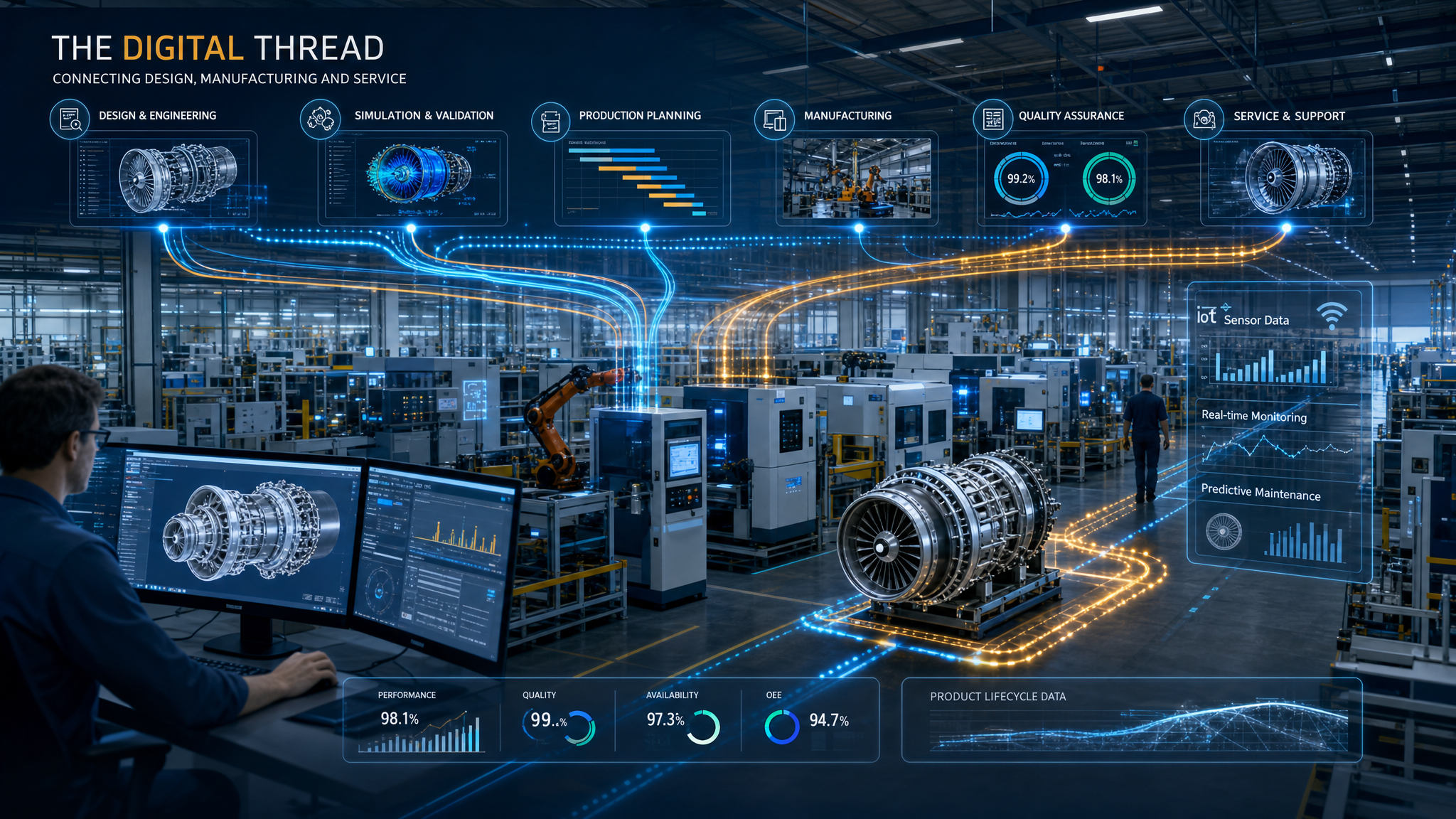
The digital thread is the connected flow of data and information across the entire lifecycle of a product. Think of it as a continuous digital narrative that begins when a product is conceived in engineering and extends through every touchpoint: design, simulation, process planning, manufacturing, quality inspection, shipping, and after-sales service.
Unlike a digital twin (which is a virtual replica of a specific physical asset), the digital thread is the data infrastructure that connects all digital twins, systems, and processes together. If the digital twin is a snapshot, the digital thread is the movie — capturing the complete story of how a product was designed, how it was made, and how it performs.
Engineering Pillar (CAD/PLM): Product designs, 3D models, bills of materials (BOMs), engineering change orders (ECOs), and simulation results. This is where the product is defined — the "design intent" that must flow downstream accurately.
Production Pillar (MES/ERP): Work orders, production schedules, machine parameters, process data, material consumption, and throughput metrics. This is where the product is built — the "as-built" reality that must align with design intent.
Quality Pillar (QMS): Inspection results, non-conformance reports (NCRs), corrective actions (CAPAs), supplier quality data, and customer complaints. This is where the product is validated — the "as-inspected" record that closes the loop between intent and reality.
Most mid-market manufacturers operate with significant gaps in their digital thread. Common symptoms include:
Engineering-to-Production Disconnect: Engineering changes are communicated via email or printed redlines. Production may be building to an outdated revision for hours or days before the change reaches the floor. Industry studies estimate that 40% of engineering changes are not properly communicated to production in organizations lacking integrated systems.
Production-to-Quality Disconnect: Quality inspectors work from printed inspection plans that may not reflect the latest engineering specifications. Non-conformance data is captured in separate systems (or worse, paper logs) that are not linked to specific production batches, machines, or operators.
Traceability Gaps: When a customer quality issue arises, tracing the problem back to its root cause requires manual detective work across multiple disconnected systems. What should take minutes takes days — or the root cause is never definitively identified.
The financial impact is substantial. Manufacturers with broken digital threads experience 2-3x higher scrap rates, 40% longer time-to-market for new products, and significantly higher warranty costs compared to digitally connected competitors.
Phase 1 — Data Audit and System Mapping (Months 1-3): Before connecting systems, you need to understand what you have. This phase involves inventorying all existing systems (CAD, PLM, ERP, MES, QMS, spreadsheets, paper-based processes), mapping data flows between them, and identifying the critical gaps where information is lost, delayed, or manually re-entered. OPZ360's Digital Transformation Readiness Assessment is an excellent starting point for this phase.
Phase 2 — Foundation Integration (Months 4-6): Start with the highest-impact connection: linking your engineering/PLM system to your production/ERP system. This ensures that BOMs, routings, and engineering changes flow automatically from design to production. Modern integration platforms and APIs make this achievable without replacing existing systems.
Phase 3 — Quality Loop Closure (Months 7-9): Connect your quality management system to both engineering and production data. This enables automated inspection plan updates when engineering changes occur, real-time quality data collection linked to specific production batches, and closed-loop corrective action processes that feed back into design and process improvements.
Phase 4 — Advanced Analytics and Optimization (Months 10-12): With a connected digital thread in place, unlock advanced capabilities: real-time production dashboards that combine engineering, production, and quality KPIs; AI-powered quality prediction based on process parameter analysis; and automated compliance reporting for regulatory and customer requirements.
Implementing a digital thread does not necessarily require replacing your existing systems. Key technology enablers include:
The digital thread touches every aspect of manufacturing operations. Within the Exceleor family of brands, our sister companies provide specialized expertise for key elements of your digital thread:
Manufacturers who successfully implement a digital thread report transformative results:
Perhaps most importantly, a connected digital thread positions your organization for the next wave of manufacturing innovation — from AI-driven design optimization to autonomous quality management.
The digital thread may sound complex, but the journey begins with a single step: understanding where your critical data gaps exist today. OPZ360 specializes in helping mid-market manufacturers assess their current state, prioritize high-impact connections, and build practical integration roadmaps that deliver value at every phase.
Ready to connect your design, production, and quality systems? Contact our team to discuss your digital thread strategy, or explore our case studies to see how manufacturers like you have achieved enterprise-wide connectivity.
The digital thread is one of the most powerful yet underappreciated concepts in modern manufacturing. It represents a seamless, integrated flow of data across the entire product lifecycle — from initial design through production, quality assurance, delivery, and even field service. When implemented effectively, it transforms disconnected islands of information into a unified data backbone that drives visibility, traceability, and agility across your entire enterprise.
For mid-market manufacturers still running disconnected systems, the digital thread is not a luxury — it is becoming a competitive necessity. At OPZ360, we help manufacturers map, plan, and implement their digital thread strategy with practical, phased approaches that deliver measurable value at each stage.
What Exactly Is the Digital Thread?
The digital thread is the connected flow of data and information across the entire lifecycle of a product. Think of it as a continuous digital narrative that begins when a product is conceived in engineering and extends through every touchpoint: design, simulation, process planning, manufacturing, quality inspection, shipping, and after-sales service.
Unlike a digital twin (which is a virtual replica of a specific physical asset), the digital thread is the data infrastructure that connects all digital twins, systems, and processes together. If the digital twin is a snapshot, the digital thread is the movie — capturing the complete story of how a product was designed, how it was made, and how it performs.
The Three Pillars of the Digital Thread
Engineering Pillar (CAD/PLM): Product designs, 3D models, bills of materials (BOMs), engineering change orders (ECOs), and simulation results. This is where the product is defined — the "design intent" that must flow downstream accurately.
Production Pillar (MES/ERP): Work orders, production schedules, machine parameters, process data, material consumption, and throughput metrics. This is where the product is built — the "as-built" reality that must align with design intent.
Quality Pillar (QMS): Inspection results, non-conformance reports (NCRs), corrective actions (CAPAs), supplier quality data, and customer complaints. This is where the product is validated — the "as-inspected" record that closes the loop between intent and reality.
The Cost of a Broken Digital Thread
Most mid-market manufacturers operate with significant gaps in their digital thread. Common symptoms include:
Engineering-to-Production Disconnect: Engineering changes are communicated via email or printed redlines. Production may be building to an outdated revision for hours or days before the change reaches the floor. Industry studies estimate that 40% of engineering changes are not properly communicated to production in organizations lacking integrated systems.
Production-to-Quality Disconnect: Quality inspectors work from printed inspection plans that may not reflect the latest engineering specifications. Non-conformance data is captured in separate systems (or worse, paper logs) that are not linked to specific production batches, machines, or operators.
Traceability Gaps: When a customer quality issue arises, tracing the problem back to its root cause requires manual detective work across multiple disconnected systems. What should take minutes takes days — or the root cause is never definitively identified.
The financial impact is substantial. Manufacturers with broken digital threads experience 2-3x higher scrap rates, 40% longer time-to-market for new products, and significantly higher warranty costs compared to digitally connected competitors.
Building Your Digital Thread: A Phased Approach
Phase 1 — Data Audit and System Mapping (Months 1-3): Before connecting systems, you need to understand what you have. This phase involves inventorying all existing systems (CAD, PLM, ERP, MES, QMS, spreadsheets, paper-based processes), mapping data flows between them, and identifying the critical gaps where information is lost, delayed, or manually re-entered. OPZ360's Digital Transformation Readiness Assessment is an excellent starting point for this phase.
Phase 2 — Foundation Integration (Months 4-6): Start with the highest-impact connection: linking your engineering/PLM system to your production/ERP system. This ensures that BOMs, routings, and engineering changes flow automatically from design to production. Modern integration platforms and APIs make this achievable without replacing existing systems.
Phase 3 — Quality Loop Closure (Months 7-9): Connect your quality management system to both engineering and production data. This enables automated inspection plan updates when engineering changes occur, real-time quality data collection linked to specific production batches, and closed-loop corrective action processes that feed back into design and process improvements.
Phase 4 — Advanced Analytics and Optimization (Months 10-12): With a connected digital thread in place, unlock advanced capabilities: real-time production dashboards that combine engineering, production, and quality KPIs; AI-powered quality prediction based on process parameter analysis; and automated compliance reporting for regulatory and customer requirements.
Technology Enablers
Implementing a digital thread does not necessarily require replacing your existing systems. Key technology enablers include:
- Integration Middleware: Platforms like MuleSoft, Boomi, or open-source alternatives that connect disparate systems through APIs and standardized data formats
- Data Lakes: Centralized repositories that aggregate data from all systems, enabling cross-functional analytics without disrupting source systems
- Industry Standards: Formats like QIF (Quality Information Framework), STEP (Standard for the Exchange of Product Data), and MTConnect provide standardized vocabularies for manufacturing data exchange
- Cloud Platforms: Cloud-based PLM, MES, and QMS solutions increasingly offer built-in integration capabilities and open APIs
Ecosystem Support for Your Digital Thread
The digital thread touches every aspect of manufacturing operations. Within the Exceleor family of brands, our sister companies provide specialized expertise for key elements of your digital thread:
- ExceleorQMS provides the compliance and quality management layer of your digital thread, ensuring that quality data flows seamlessly into the connected data backbone and meets ISO 9001, AS9100, and IATF 16949 requirements.
- ConsultFactor specializes in the change management and organizational transformation required when implementing a digital thread — helping your teams adapt to new workflows, cross-functional collaboration, and data-driven decision-making.
The Competitive Advantage of a Connected Enterprise
Manufacturers who successfully implement a digital thread report transformative results:
- 60-80% reduction in time to trace quality issues to root cause
- 30-40% faster new product introduction cycles
- 25-35% reduction in scrap and rework costs
- 50% fewer engineering change communication errors
- Near-complete lot-level traceability for regulatory compliance
Perhaps most importantly, a connected digital thread positions your organization for the next wave of manufacturing innovation — from AI-driven design optimization to autonomous quality management.
Start Connecting Your Enterprise
The digital thread may sound complex, but the journey begins with a single step: understanding where your critical data gaps exist today. OPZ360 specializes in helping mid-market manufacturers assess their current state, prioritize high-impact connections, and build practical integration roadmaps that deliver value at every phase.
Ready to connect your design, production, and quality systems? Contact our team to discuss your digital thread strategy, or explore our case studies to see how manufacturers like you have achieved enterprise-wide connectivity.